
The mentorship gap
AI can help new lawyers to search, summarise, draft, and reason. But can it teach?


Thanks to AI, junior lawyers are being exposed to more complex legal work far earlier in their careers.
Yet many lack the experience to test, challenge, or refine AI outputs.
So how can junior lawyers learn legal judgment and argumentation in the age of AI?
Drawing on voices from across the profession, this report investigates new models for mentoring, training, and preserving human excellence in the AI era.


Our January 2026 survey of 873 UK-based legal professionals found:
65%
of lawyers said they are faster when using legal AI tools such as Lexis+ AI. A third (31%) said their quality of work is higher.
Yet AI is raising fundamental questions about how new lawyers are learning the law.

72%
have concerns junior lawyers using AI will struggle to develop legal reasoning & argumentation.

69%
are worried new lawyers lack verification and source-checking skills.

Only
2%
of lawyers believe AI strengthens their learning.
What's the solution?
Training new lawyers to use AI as a “thinking partner” rather than a shortcut.


Is AI stopping new lawyers from learning age-old legal skills?
For experienced lawyers, using AI to tackle repetitive, time-consuming tasks is a no-brainer. Fast-tracking legal research, creating first drafts, summarising documents — these are the dominant use cases today, with new ones emerging almost daily.
But the same tools raising productivity for senior lawyers may be quietly reshaping how junior lawyers learn the fundamentals of legal judgment.
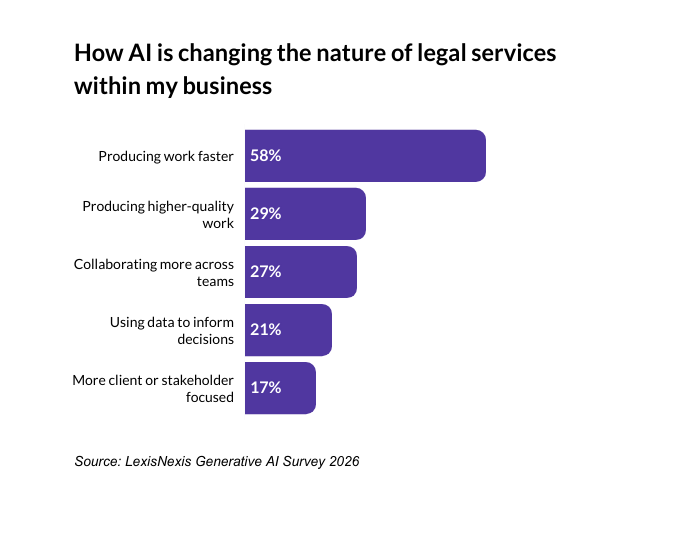
The productivity gains are clear. More than half (58%) of lawyers using AI tools of any description are producing legal work faster, our January 2026 survey of the UK legal market found. This rose to 65% for those using paid legal platforms like Lexis+ AI.
Two-third of lawyers using paid legal platforms say they are producing work faster.
Additionally, a notable proportion of lawyers admitted their work is better when they use AI. A third (29%) said their legal work is of a higher quality, rising to 31% for those relying on paid legal AI platforms.
The learning gaps are just as stark. For junior lawyers — especially those just starting out — the same time-saving benefits may come at a hidden cost. Pouring over lengthy contracts, interrogating every clause, and immersing yourself in case law may not be glamorous, but these tasks have traditionally been how legal judgment is formed.
New lawyers will adopt AI quickly, says Bhavisa Patel, Director of Legal Technology at Eversheds Sutherland.
"They won’t yet have the experience to know when an output is wrong, incomplete, or could be pushed further."
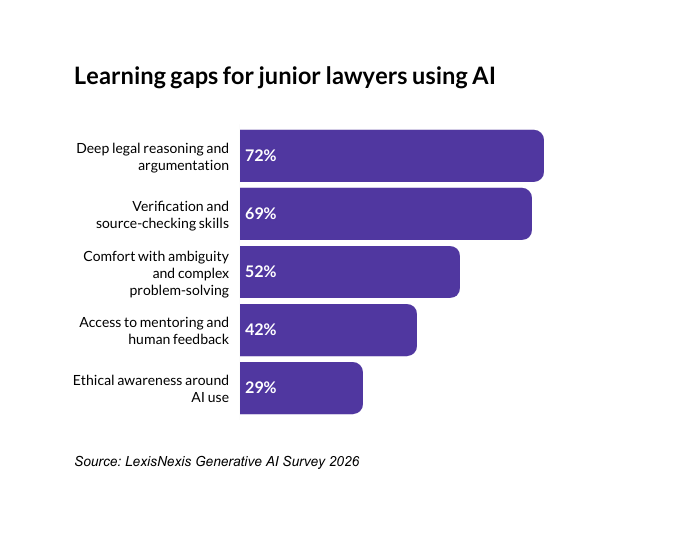
The biggest skills gap among junior lawyers isn’t technical knowledge, but deep legal reasoning and argumentation (72%) — precisely the capabilities developed through slow, hands-on legal work.
Deep legal reasoning and accuracy are the top learning gaps
This concern is already being felt in legal education. One senior lecturer at a well-known university said this is particularly true for lawyers in training.
"No critical reasoning, no belief in themselves and no confidence."
This shift isn’t the erosion of legal training, but a reordering of it. Emma Danks, Head of UK Corporate at Taylor Wessing and co-head of the firm's international corporate group, says as AI takes on the routine, high volume tasks that have traditionally shaped the early years of a legal career, junior lawyers will find themselves engaged in more complex work far earlier.
"That accelerates development, but it also means we need to be deliberate about how we build judgment and strategic thinking alongside technical capability."
Many others flagged verification and source-checking skills as a knowledge gap amongst junior lawyers (69%). Interestingly, only 2% of respondents said AI mainly strengthens learning.
To succeed lawyers will need the skills to assess whether an "AI-generated output is accurate, appropriate, and aligned with the client’s needs," says Patel.
One in-house lawyer said "Junior lawyers are missing out on developing legal research skills. They don't necessarily know how to access primary sources and verify AI output."
Another senior in-house leader said "I am fearful that future law graduates will have depended too much on LLMs for the most fundamental research, analysis and drafting tasks."
This doesn’t mean AI is the problem — but it does change what leadership must focus on.
There will be less of a focus on technical mastery and more on strategic vision, adaptability, and people management, says Jagdip Panesar, Global Head of Partner Development and Coaching at Clifford Chance.
"History shows that new technologies, such as CAD for architects or MRI for doctors, raised concerns about losing foundational skills, but in practice, they expanded learning opportunities and exposed professionals to more complex challenges."
"This makes judgment and the ability to integrate diverse information even more important, ultimately enhancing the service provided."
The challenge isn’t whether to use AI, but how deliberately it’s used. Bilal Farooq, Director of Luton-based law firm, Greystone Solicitors, says AI can be used to increase collaboration and knowledge-sharing.
"Firms that use AI well will see stronger collaboration across teams, as lawyers spend less time researching and more time working together on strategy and client outcomes."
Alessandro Galtieri, Deputy General Counsel at Colt Technology Services, says AI will automate the most boring parts of knowledge management: collection data, maintaining it, and linking to internal sources.
"If everything that all our colleagues have ever done becomes immediately available to us, it is difficult to see how that could not result in enhanced performance and collaboration."
Shoosmiths Director of Client Tech and Service Improvement, Tony Randle, says AI will drive firms to centralise and codify know-how, shifting it from individual memory into shared systems accessible to everyone.
"This not only enables AI to apply knowledge consistently but also elevates firmwide quality by making the collective experience of hundreds of lawyers available to each individual."
"Clients and firms alike benefit when knowledge becomes more transparent, accessible, and standardised," he says.
How do firms redesign early legal careers so judgment is built, not bypassed? How do they embed verification, accuracy, and critical reasoning in an AI-enabled workflow?



AI is not a shortcut. It's a thinking partner for the next generation of lawyers
As AI becomes embedded in legal workflows, leaders face a choice: treat it as a productivity hack, or as a tool that reshapes how lawyers think, learn, and exercise judgment.
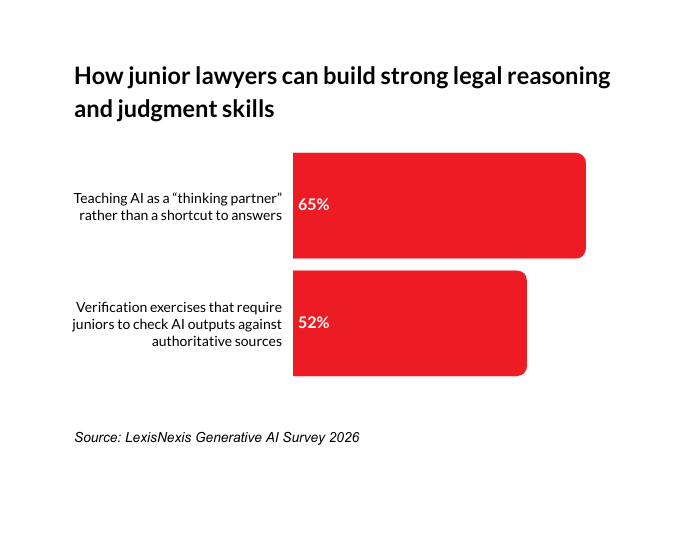
The solution, according to two-thirds (65%) of respondents in our survey, is to reposition how junior-level lawyers view AI. It's not a shortcut, but instead a “thinking partner”.
Framed this way, AI becomes a tool for challenge, iteration, and validation — not a replacement for legal reasoning. Tools like Lexis+ AI are designed to support this approach, grounding AI-generated answers in authoritative legal sources and making verification part of the workflow.
Two-thirds believe treating AI as a “thinking partner” will improve legal judgment.
Kennedys UK Managing Partner, Ben Aram, says legal technical skills — understanding and knowing the law and how to apply it — will continue to matter.
"Technology literacy is becoming a newer skill for the lawyer leader toolbox, which wasn’t always the case in the past. Now, lawyers need to be able to think quickly, and commercially, and having great attention to detail when reviewing AI outputs."
Randle from Shoosmiths says his firm is deliberately designing its AI tools to be learning companions as much as productivity enablers.
"Rather than limiting junior lawyers’ development, we expect AI to accelerate their journey to proficiency by replacing much of the repetitive groundwork with reasoning and explanation."
Galtieri at Colt Technology Services believes using AI for drafting or redlining will have little impact on the development of junior lawyers.
"Let’s face it – it is often just drudgery," he argues.
"The issue is developing the critical and commercial skills needed to instruct the machine, exactly as you do with a law firm."
Providing context and being really clear on what your objectives are is crucial for a useful work product, says Galtieri.
"In a short time, having the technical skills to use AI to spot contradicting clauses in a 300-page contract will sound about as basic as being able to spell properly or format a document in Microsoft Word."
This will free up more time for junior lawyers to add more value as strategic advisers, says fellow in-house legal leader, Candice Donnelly.
"This isn't just legal knowledge but commercial judgment, business insight, and the ability to add clear direction into complex situations."
AI does not replace those strengths, but it can create more space for them to shine by taking on the more mechanical work, she believes.
"As AI handles more of the ‘what’, leaders will be defined by their ability to shape the ‘why’ and the ‘how’. "
Panesar from Clifford Chance says it's up to leaders to guide their teams through technological change, foster innovation, and ensure ethical use of AI.
"Leaders will need to champion continuous learning and cultivate a culture where technology augments, rather than replaces, human expertise."
Farooq from Greystone Solicitors says mentorship plays a critical role in developing junior lawyers’ legal judgment and professional confidence.
"Access to legal information may be increasingly efficient, but judgment, ethical awareness, and client-handling continue to be learned through close engagement with experienced lawyers."
Confidence will increase through guided decision-making, structured feedback, relevant training programmes and exposure to clients, he says.
The biggest shift will be how we support our people through this transition, says Patel from Eversheds Sutherland.
"Leaders will need to embed a mindset where people understand the strengths and limitations of AI, feel confident using it responsibly, and know how to review and refine outputs."
An additional half (52%) supported verification exercises that require juniors to check AI outputs against authoritative sources, reinforcing accuracy, scepticism, and professional responsibility.
Lexis+ AI provides AI-generated answers with linked citations to trusted sources such as Halsbury’s Laws and All England Law Reports.
Danks from Taylor Wessing says leaders will need "curiosity, adaptability, and a willingness to challenge their own ways of working."
This shift also elevates the role of junior lawyers to be drivers of change.
"Client expectations are evolving. As AI opens up new possibilities, clients will look to firms that can anticipate emerging needs rather than simply deliver efficiently."
Curiosity, adaptability, and a willingness to challenge their own ways of working will also be critical.
For some firms, this shift is already underway, with AI influencing not only how legal work is done, but how people are developed and value is defined.
John Craske, Chief Innovation & Knowledge Officer at CMS, says the biggest changes driven by AI will be felt in how firms organise their work and develop their people.
"We’re focused on supporting our clients and, as client expectations develop in response to AI, we will meet our clients where they need us and deliver what they need. That means using AI effectively and responsibly, and evolving our business to respond to the impact of AI."
For Craske, AI heightens the skills that define strong legal leadership.
"The best partners understand our clients deeply: their business objectives, how they like to work, what they need from their external lawyers. AI will just sharpen the need for these skills and in the future AI will be part of the team."
In the AI-enabled legal profession, the real differentiator is no longer in who adopts the tools first, but who knows how to think with them.


What leaders choose to measure matters
Junior lawyers may be adopting AI quickly, but confidence is not keeping pace with capability. While many are comfortable using the technology day-to-day, they are more likely than senior colleagues to worry about keeping up with rapid change — and about becoming overly reliant on AI in the process.
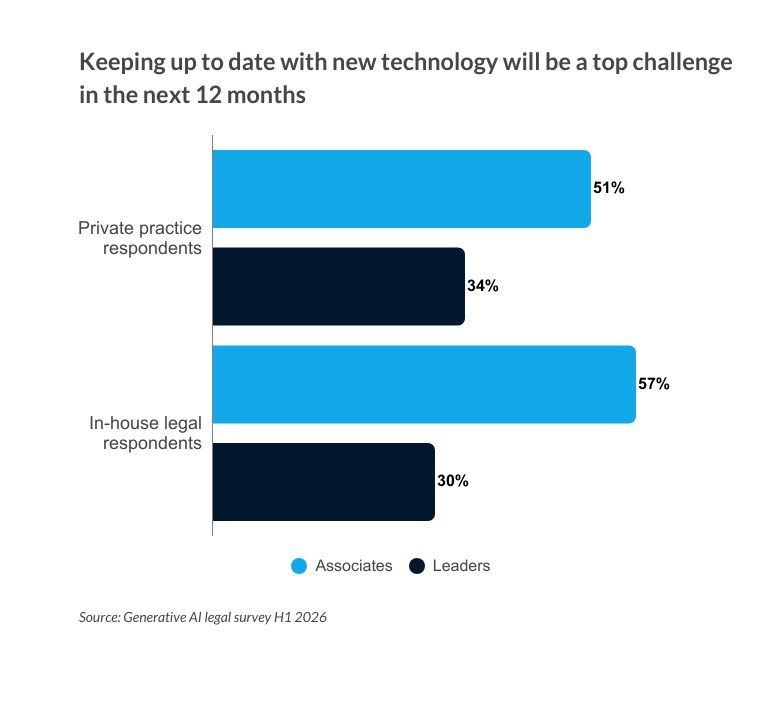
Half (51%) of associates in law firms said keeping pace with new technology will be a top challenge over the next 12 months, compared with just 34% of leaders. A similar pattern emerged in-house, with 57% of in-house lawyers flagging this concern, versus only 30% of general counsel and legal leaders.
Junior-level lawyers are more concerned about keeping up with new technology
Concerns about dependency are also higher among junior lawyers. Just over half (51%) said they worry about becoming too reliant on AI, compared with 45% of legal leaders.
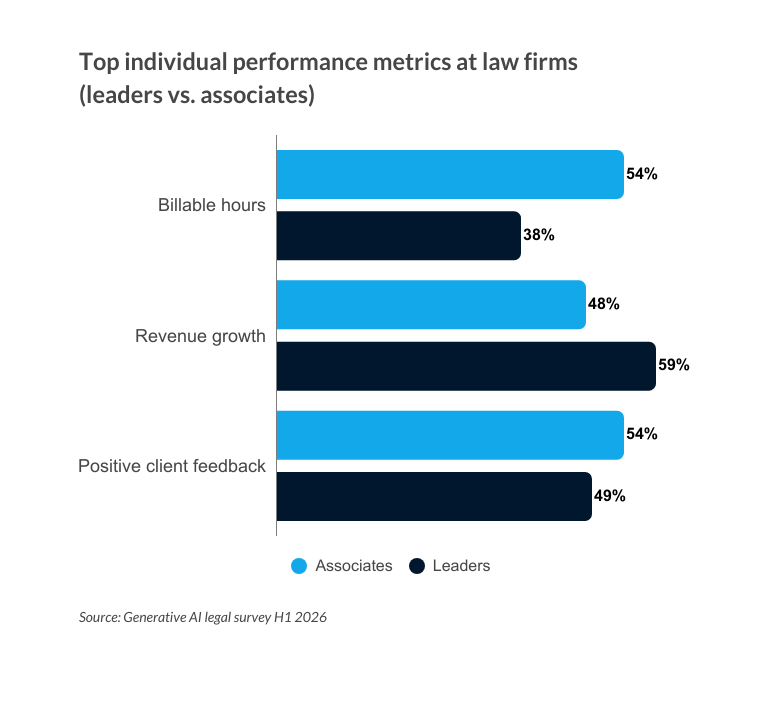
This tension may also reflect how success is defined at different levels of the profession. Among law firm leaders, revenue growth ranks highest as a performance metric (55%), followed by positive client feedback (49%) and billable hours (38%). Associates place greater emphasis on billable hours and client feedback (both 54%), with revenue growth close behind (48%). What gets measured and rewarded — inevitably shapes how AI is perceived, trusted, and used.
What leaders choose to prioritise inevitably shapes how AI is used. Where billable hours dominate, speed and throughput are likely to become the primary focus. Where client feedback is prioritised, accuracy, quality, and client care take precedence. And where revenue growth leads, AI is more likely to be directed towards innovation, new services, and upsell opportunities.
For firms prioritising quality and client trust, AI tools grounded in authoritative legal content such as Lexis+ AI can help reinforce those priorities in day-to-day work.
For junior lawyers, these priorities act as powerful cues. They influence not only how AI is deployed day-to-day, but how much time is spent questioning outputs, verifying sources, and exercising judgment. What gets measured and rewarded quickly becomes what gets optimised.
For clients, these internal signals are increasingly visible. Emma Danks of Taylor Wessing says expectations are evolving as AI opens up new possibilities.
“Clients will look to firms that can anticipate emerging needs rather than simply deliver efficiently. The future lies in outcome-focused, technology-enabled legal solutions, and firms that embrace this mindset will lead the market.”
As AI becomes more embedded in legal work, partners play a critical role in setting the standard for responsible use. Patel stresses that speed alone is not the goal.
“AI may accelerate technical competence, but speed does not automatically equal quality. Future partners and leaders will need strong judgment — the ability to assess whether an AI-generated output is accurate, appropriate, and aligned with the client’s needs.”
At Taylor Wessing, leaders are already seeing the impact of these choices.
“We are also seeing a clearer divide between those who embrace AI-enhanced workflows and those who do not. This is influencing conversations about performance, compensation, and career progression. We are beginning to value judgment, client leadership, creativity, and innovation more than purely technical output.”
Good use of AI means using it to accelerate the mechanics, such as drafting, research and automated analysis, while keeping people firmly in charge of purpose, nuance, and direction, says Donnelly, who formerly was the Director of Legal, Corporate at Skyscanner.
"Human judgment will remain essential to ensure the final output is not just accurate, but aligned with business strategy, risk attitude, culture, and commercial needs."
As AI accelerates legal work, it is leadership priorities — not the technology itself — that will determine whether judgment is strengthened or sidelined.

Closing the mentorship gap
Today’s junior lawyers aren’t learning legal judgment in quite the same way as those who came before them. They’re moving faster, tackling more complex work earlier, and relying on tools that simply didn’t exist a few years ago. AI is a big part of that shift — and it’s up to leaders to make sure judgment keeps pace with speed.
There’s no doubt the benefits are real. Efficiency improves, and junior lawyers are exposed to higher-value work sooner. But judgment, confidence, and critical thinking are still built through experience: testing ideas, checking sources, getting things wrong, and learning why. Those lessons don’t automatically come from faster workflows or better tools.
Closing the mentorship gap means doing more than rolling out AI. It means being clearer about expectations, spending more time coaching people on how to question AI outputs, and being explicit about what “good” legal judgment actually looks like day-to-day.
The teams that get this right won’t treat AI as a shortcut. They’ll treat it as a thinking partner — one that helps people learn faster without skipping the fundamentals. And in the long run, that’s how firms will build lawyers who are not just more productive, but more confident, capable, and trusted too.


Discover how trusted, cited legal AI can support judgment, verification, and confident legal decision-making.
Survey methodology
This survey took place in December of 2025 to January of 2026. It included 873 legal professionals from the UK and Ireland.